
Part 1: Enter Ghost
Dispatches from Elvisfest at the end of America

HORATIO: If thou hast any sound or use of voice,
Speak to me.
If there be any good thing to be done
That may to thee do ease and grace to me,
Speak to me.
If thou art privy to thy country’s fate,
Which happily foreknowing may avoid,
O, speak!
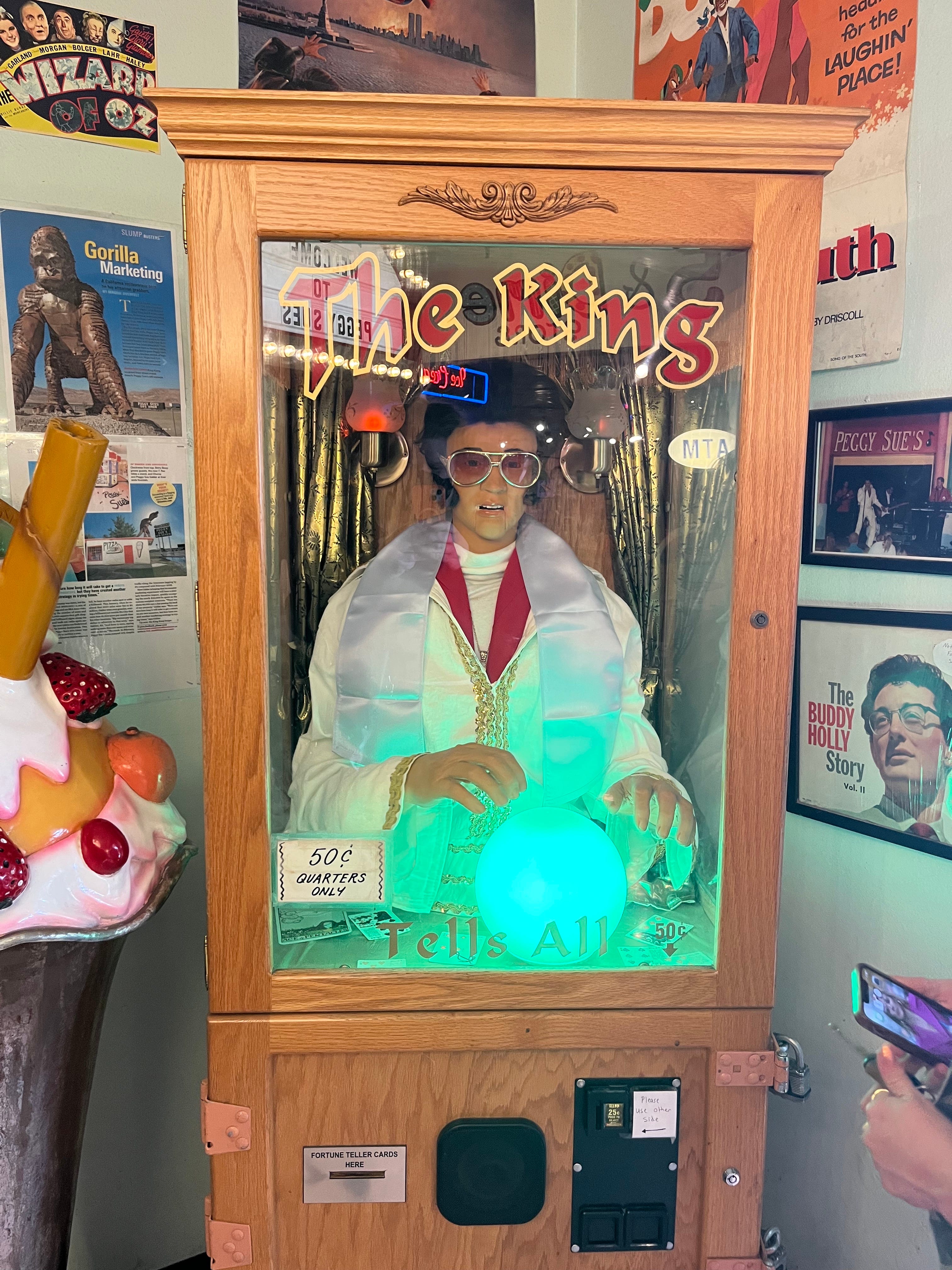
I am midway through life, staring down the returning imperial boomerang. I spent my higher education (and a portion of my career) researching the contours of gods, nationalism and empire, so I guess I was more prepared than some. The last year, however, has been concussive, and I am embarrassed that my familiarity with autocratic shock and awe didn’t soften the consecutive blows. So to cope, I have returned to peak-pandemic agoraphobia and peak-early 20s depression, working in my cluttered backyard for hours to feel some connection to something. I would turn over soil and saw branches until I was too tired to hear all the worst case scenarios that sloshed around my skull, but they only got louder. How would I be able to pay rent if I lost my job, which is directly in this administration’s sights? How long would I be able to get my antidepressants or a new IUD? Would my friends and loved ones be disappeared or forcibly detransitioned? Where would I evacuate to if the hills burn? Is it all downhill from here, even though I just got some shred of stability?
And then, to my surprise, I would be thinking about Elvis Presley.
It was always strange, as I was never really familiar with him. Maybe the coping mechanisms that got me through my suicidal years didn’t work anymore (or was this an antidepressant side effect?) Maybe this was my misplaced cultural Catholicism yearning for something unknowable and divine. Yes, divine. As the American Idea is re-evaluated and rebranded around us all, our national gods are too. He is one of them, alongside the strange company of certain presidents (Washington, Lincoln, Theodore Roosevelt), Marilyn Monroe, and Michael Jackson. In our usual American extravagance, our national pantheon is both cultural export and consumer good. This comes at the cost of their humanity, as fame requires human sacrifice to be assimilated totally into the national and global milieu. Because of his godhood, I never knew Elvis Aaron Presley as a person, just a Mississippi boy born into poverty after his stillborn twin. All I knew was a shallow memetic collage that was central to the second 1950s revival that coincided with my childhood, no more than an empty suit full of hound dogs and peanut butter and banana sandwiches. But even at his most diluted, he is as the bewildering Mojo Nixon song accurately proclaims. Even when intentionally excluded from my childhood musical upbringing (my parents are not fans), he is the unavoidable warp of our cultural fabric. He may have been a washed-up has-been when my parents honed their music tastes, but his pompadours and flamboyant outfits were central to The Smiths and The Clash’s visual brand. After all, a young Declan Patrick MacManus, my mother’s favorite musician for decades, did not choose the stage name Buddy or Carl Costello. He was always there, I just couldn’t see him. Not yet, at least.
In retrospect, it wasn’t surprising that it was Stephanie who would start me on this journey. Ever since I met her at our college radio station a lifetime ago, she has not only been one of my closest friends, but also generously shares her astute cultural observations and eerily-timely obsessions. So when she kept humming an unfamiliar song under her breath on an unseasonably misty afternoon in 2022, I paid attention. As we strolled through the tombstones in Hollywood Forever Cemetery, I’d catch her quietly repeating ‘caught in a trap/can’t walk out/because I love you too much, baby’ like an incantation. The trailer to Baz Luhrmann’s Elvis biopic had just dropped, and she said that it made her feel something indescribable. I told her I was looking forward to her ‘Elvis phase’ and meant every word. When we watched the movie together six months later (her thirteenth watch, my first), I knew exactly how she felt. I expected an immediate camp classic, only to find myself rattled and spooked when the credits finally rolled. The movie is not a perfect biopic (it is neither perfect nor a biopic, according to Stephanie), and is instead a parable and a call for action. If you make it through the bewildering two hour and forty minute Passion of Elvis, biblical naïf betrayed by his arch-capitalist carny manager, you are presented with a mandate. You must reclaim Elvis, piece his fragmented and often-embarrassing elements together using the provided framework, and see him plainly before it is too late. Because if you forget him or do not reclaim him, he will be doubly damned from his humanity and will live eternally and incorrectly as something he isn’t. What a fascinating dangling thread to yank on, two years into the COVID-19 pandemic. And what a provocative statement for me and my academic background! Stephanie and I gleefully dove into his cultural footprint together, writing furiously throughout.
Three years later, my 30-odd page draft is unfortunately quaintly out of date. Baz’s demand for new myths for old gods was a perfect foil of the then-ascendant QAnon mythos, which I was uncomfortably familiar with thanks to a former job. But Qanon is now mainstream, its signs and slogans in many of the president’s social media posts and its adherents in the federal office. My central thesis- that America is ahistorical, thus our culture is too- was plain for even the most casual observer to see. And in the sections about Elvis himself, I was writing around a central void. He was clearly a national myth, a metonymy for the mythos of the American dream, the aegis of white American masculinity, and the great cultural synthesizer who absorbed Black American culture and made it digestible for the white American mainstream. But did I know him at all, and was it even possible to? I threw endless metaphors and academic musings into the void, and it only grew. I missed a promised joint pilgrimage to Tupelo and Graceland because I was too financially strapped, and succumbed to dread and burnout as a new golden age of Elvis memes dawned. Baz’s mandate succeeded partially- he was back in the cultural conversation, but as Dada Johnny Bravo who lobs hand grenades at press conferences, croons while his ‘grandson’ sweatily eats fast food and chokes on water, and mourns being imprisoned in a bowling ball. They all (unfortunately) make me laugh, though some feel like seeking out long lost scapegoats as a new void beckons. It is borderline sacrilege, but we can no longer ignore that our old myths of exceptionalism and beatitude are quaintly out-of-date as well. I cannot garden so much that I escape the unbearable now. And Elvis is everywhere again, and I cannot escape him if I try, algorithmically or otherwise. I am haunted by him, and I still barely know him. He is the apparition at our communal door, again, at what seems like the end of things. I knew, somehow and sometime soon, I would have to confront him.